Designing Tactics around WARDOGS
The thought process of designing Tactics in WARDOGS vs other games
The difference between combined arms vs solo play
In platoon level play and above in any video game, organization of players is very different than how you may have ever played games before.
In games like Call of Duty, Apex, Rainbow Six, Counterstrike, Battlefield etc. a "Squad" is only 4 - 12 players.
Rust can get up to 30, but they usually have no organization beyond a blob/zerg.
These games have their own tactics but usually never go beyond "how the individual plays better."
In games like Arma, Squad, Hell Let Loose or Bellum, squads start to play a different role because of the rock/paper/scissors dynamic of Infantry vs Armor vs Air.
In these games, the focus is more on "How do WE play better?"
You might argue here that "battlefield is 64 players though!" Why is it lumped in with games like Call of Duty or Counterstrike? After all, the gameplay is vastly different across all of them.
Because of one thing;
Individual super soldier design
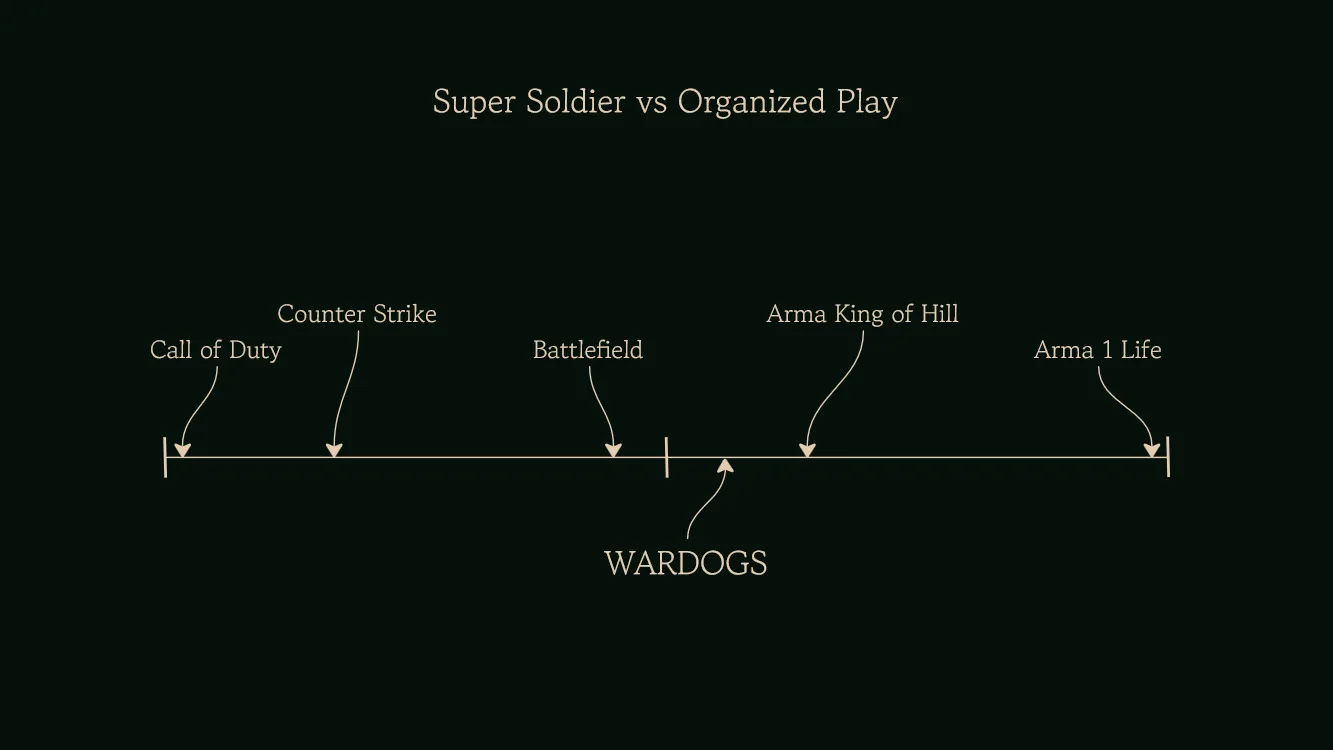
The number of players in a game doesn't make it automatically a "Combined Arms", "Organized Gameplay" or "Strategic Shooter."
The line in the sand is, "Can the average player handle dynamic threats with relative ease and what is the cost if they die?"
In battlefield, your life doesn't matter much and if you face check an M1 Abrams and it kills you, it doesn't really impact the scope of the situation much. You can just respawn with an AT rocket launcher and handle it.
In a game like Arma with a 1 Life scenario, meaning you die, you don't respawn till the next match, which could be 3 hours from now. If you face check an M1 Abrams in that game, it's a very different scenario.
An extreme version of this mechanic would be the game Foxhole, a top down war game where hundreds of players are running around fighting a war. In that game, your life literally means nothing and an insane level of coordination is required to handle dynamic threats.
How Game mechanics, dynamic threats & loadout change the tactics you use
Dynamic threats are anything that is a Scissors when you are Paper.
It's weapon systems, vehicles or ordnance that is beyond the scope of your loadout.
If you are running a sniper rifle, your scissors is a Tank, Attack chopper, Artillery or an infantry guy with an SMG 10m from you.
Those are threats you are not equipped to deal with.
LOGISTICS also plays a huge role in this equation. But logistics is really just an extension of "How fast can a dynamic threat be dealt with?"
Usually any game that has a logistics system in place, skews the game more towards organized play.
Designing tactics and strategies around the game you play
In a game like Battlefield you can jump out of your jet, shoot an enemy jet with an RPG and it'll look really cool in a clip.
In Arma or WARDOGS, you can not do that.
Some tactics work in some games, not others.
WARDOGS sits in an interesting middle ground of the Rock, Paper, Scissors scenario of game mechanics.
A Tank isn't going to wipe an Infantry Squad held up in an apartment, but it is a problem.
An Attack chopper isn't going to Wipe a FOB, but it is a problem.
A few mortars isn't going to level a FOB, but it is a problem.
These are dynamic threats because one person can not effectively counter all the threats even if they respawn.
This puts WARDOGS more in the ORGANIZED PLAY region of game design than the Solo Super Soldier.
In organized play, individuals stop being well, individual super soldiers and they start being a small piece in a machine of components all operating in unison.
This UNIT has a name, it's called THE FIRETEAM.
Discussion
- No comments yet. Corrections and after-action notes welcome.
Sign in as a clan member to comment.