The Fundamentals of Base Design
Getting started with the Basics
Welcome to the fundamentals of designing an insane base, these fundamentals can be used in any game where you can build a base.
All of this is directly from Sebastien Vauban's book "De l'Attaque et de la Defense des Places" aka "A treatise on the attack and defence of fortified places."
This book is a foundational book in military science. You will see these principles still paralleled and cited in modern military doctrine of current World Armies. In WW2 they used layered defenses in building foxholes. In Vietnam they used Artillery Mutual Support on Firebase Doctrine. The core of Fire & Maneuver is based on never leaving a unit isolated which is directly from Vauban. These fundamentals echo through military writings for the past 500 years. Napoleon Bonaparte studied this book religiously.
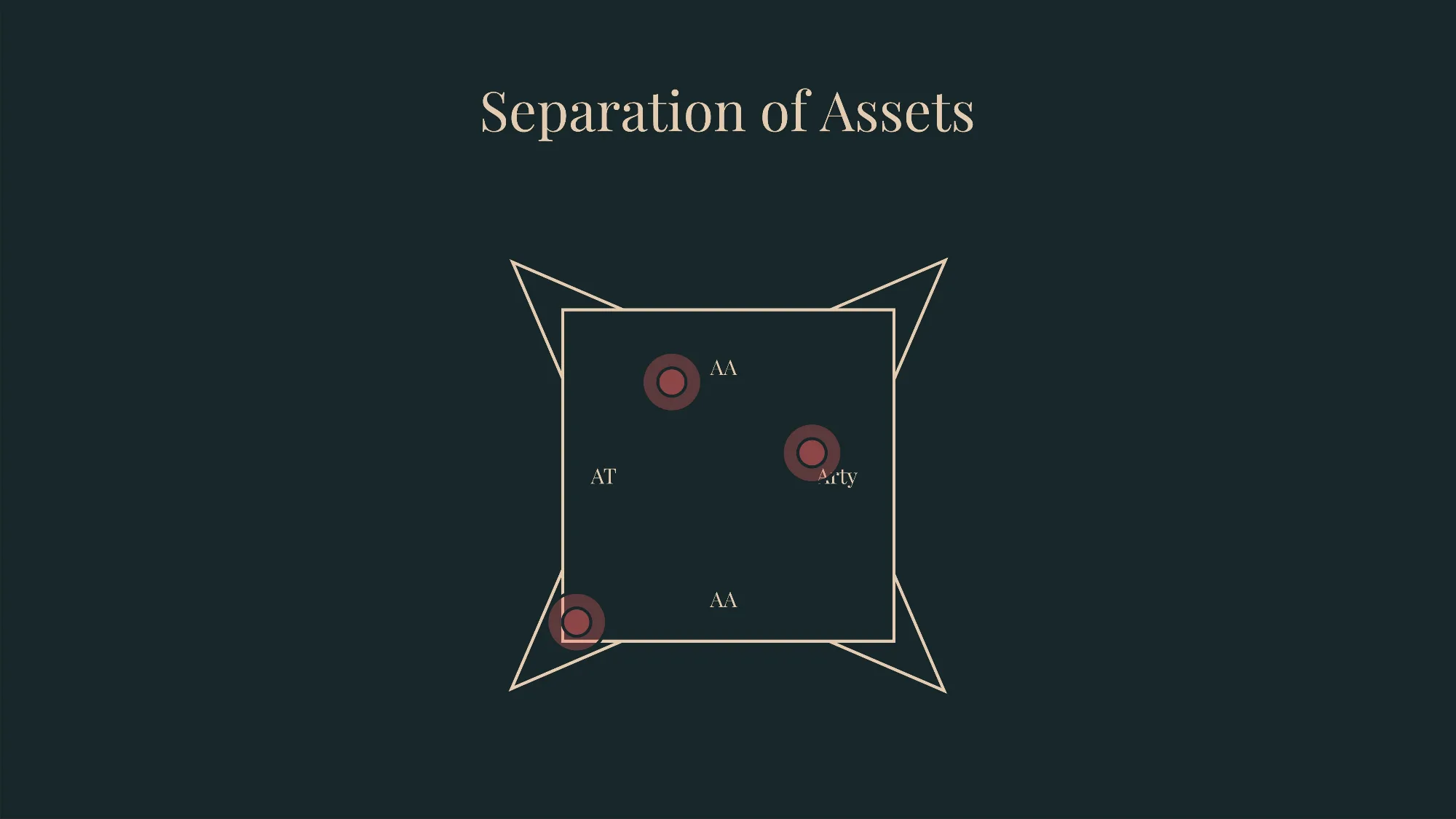
Separation of high Value Assets
Don’t ever place two high value assets next to each other to give an easy target for enemy artillery. Separation and real estate are the second best deterrent to enemy artillery,
the first being "destroy the enemy artillery before it fires."
Quotes from Vauban’s “On the Attack & Defense of Fortified Places”
gunpowder stored in covered pits away from the battery (page 148, instructions for building a bomb-mortar battery):
"Il faudra en même tems prolonger un bout de l'Epaulement, et faire un trou ou deux bien couverts à quelque distance séparée de la Batterie, pour mettre en sûreté les Poudres et les Bombes chargées."
"One must at the same time prolong one end of the Epaulement [the protective shoulder-wall], and make one or two well-covered holes at some distance, separated from the Battery, to put the Powder and the loaded Bombs in safety.
High Value Assets
Spawn APC
FOB
Drill
AA
Mortar
AT Gun
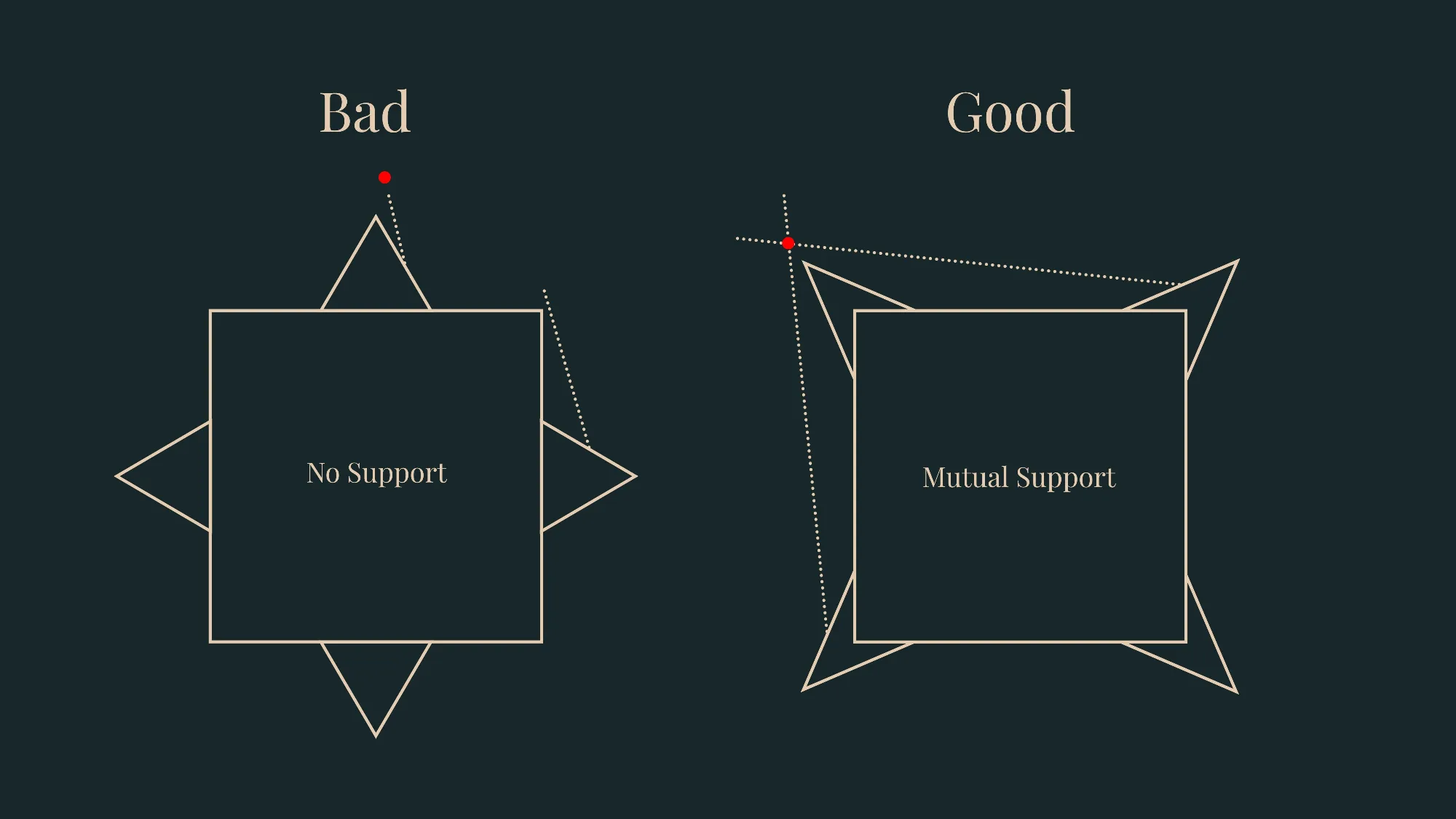
Mutual Support
Never place a bastion in the center of a wall, always on the corners.
Bastions must be able to support each other with raking fire.
An isolated structure is a soon lost structure.
Vauban
"Ne faire aucun Ouvrage qui n'en soit flanqué à bonne portée." - Page 122
"Make no Work that is not flanked by another at good range."
Defense in Depth
Multiple Lines of Defense increase the danger of an enemy's approach. Increasing the points he can be fired upon. And when these layers are compartmentalized with barbwire and traps, the enemy finds themselves stuck in a Killing Field.
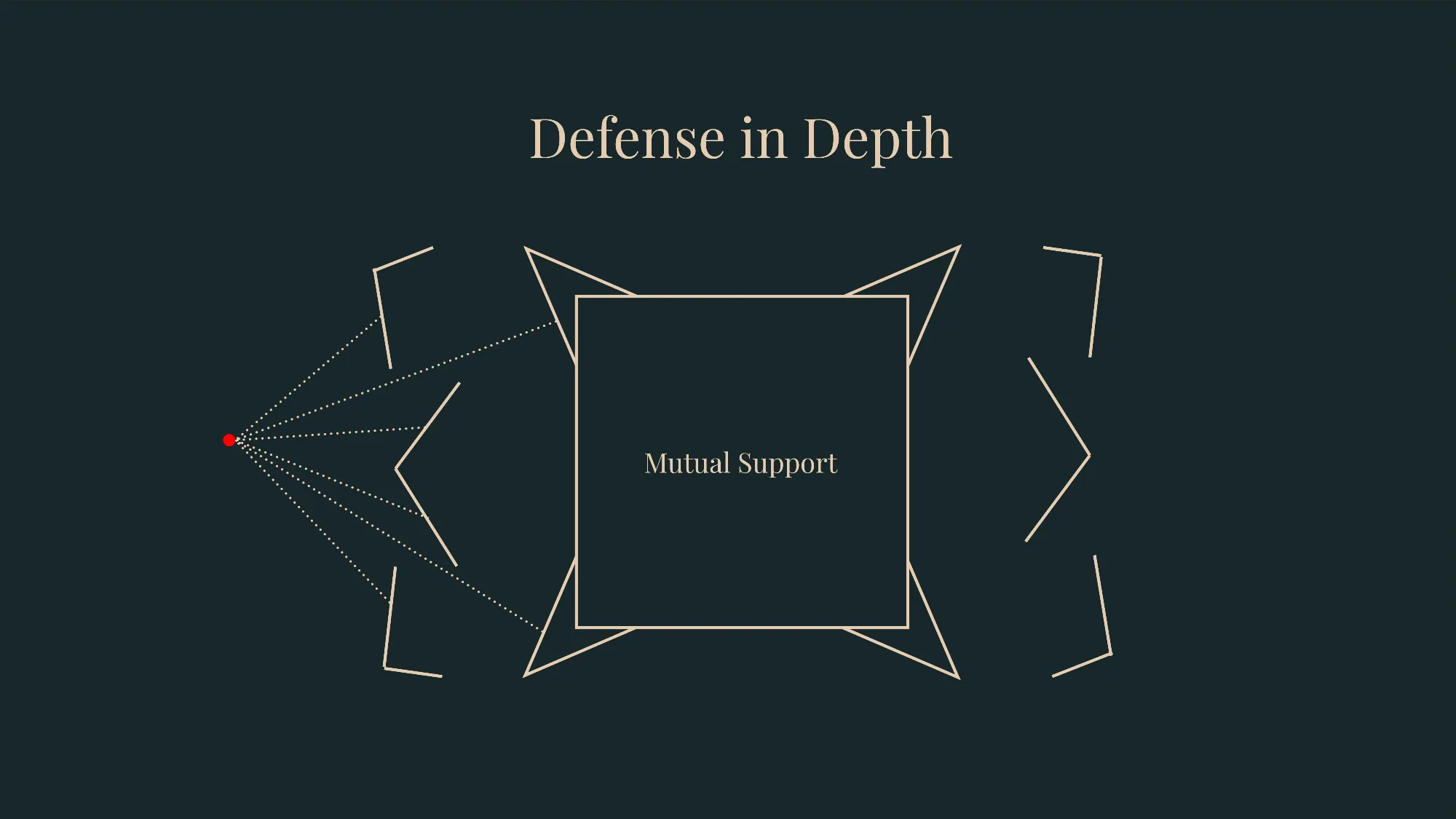
Never give the enemy a free wall of the base to breach without first attacking outer works.
Make the enemy earn the wall.
Quotes from Vauban’s “On the Attack & Defense of Fortified Places”
"Ne faire aucun Ouvrage qui n'en soit flanqué à bonne portée." - Page 122
"Make no Work that is not flanked by another at good range."
Vauban's own design checklist (page 232):
he says when fortifying real (irregular) towns, you can bend every rule except these "that all the pieces flank each other well; that the line of defense not be too long; that the parts support one another and can communicate; that all parapets be cannon-proof; and that everything be surrounded by ditches and palisades covered ways."
Brains before force (page 305, Maxim 7):
"Ne jamais faire à découvert ni par force ce que l'on peut faire par industrie; parce que l'industrie agit toujours sûrement, et que par la force on ne réussit pas toujours." — "Never do in the open or by force what can be done by craft; for craft always works surely, and force does not always succeed, and usually risks much."
Compartmentalization
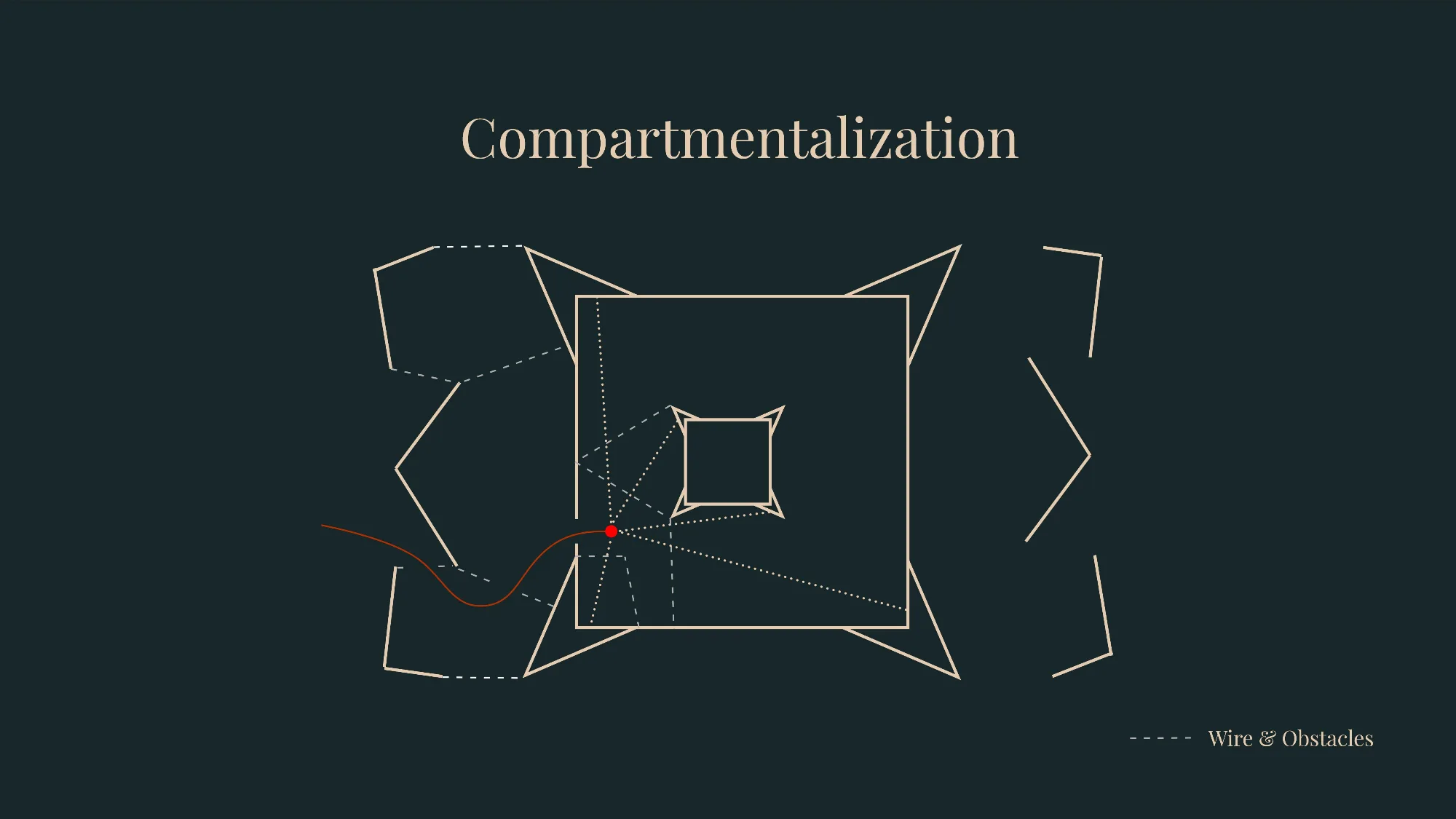
When layers of defense are compartmentalized correctly, the deeper the enemy gets into the base, the more restricted his movement becomes. The entire fortress becomes a snare entrapping him.
Rules for Compartmentalization
Never reduce a friendly's ability to maneuver if possible.
Reduce the movement of the enemy.
Use doors to allow friendlies access through compartments.
Bastion Design
Bastions can have firing positions that are raised that engage enemies out at range just like a traditional tower.
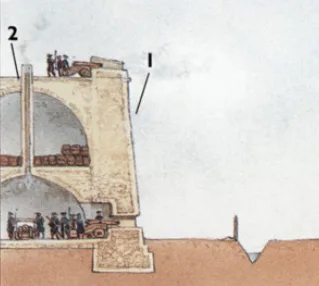
However, the firing position/room/shooting hole that is used to rake fire the walls and support the other bastions should only ever have that one window to shoot from.
Ensure that if you are rake firing the wall and supporting another bastion, you can’t be shot from another window while defending the wall.
A recon tower or regular bunker would be bad to use as a bastion unless you block off all other windows except the one covering the base wall and distant Bastion.
1. Guns sunk into the wall, firing through slanted cut embrasures, nearly impossible to silence - page 187
This is the attack treatise, Vauban warning his own siege engineers about what a competent defender's raking guns will do:
"Les Officiers d'Artillerie des Places qui sçavent leur métier ne manquent pas de mettre leur Canon sur la Courtine attaquée; moins pour tirer directement devant elle, que pour battre en écharpe sur les Logemens du Chemin-couvert... Ces Pièces, tirées par des Embrasures biaisées, coupées dans l'épaisseur des Parapets de la Courtine, incommodent fort les Logemens... Elles sont très-mal-aisées à démonter, parce que les Batteries opposées aux Flancs ne les peuvent voir; et comme leur recul est fort enfoncé, il est très-difficile de les trouver."
"The Artillery Officers of fortresses who know their trade never fail to put their Cannon on the attacked Curtain; less to fire directly in front of it than to rake obliquely across the Lodgments of the Covered Way... These Pieces, fired through slanted Embrasures cut into the thickness of the Curtain's Parapets, greatly trouble the Lodgments... They are very hard to dismount, because the Batteries opposed to the Flanks cannot see them; and as their recoil position is deeply sunken, it is very difficult to find them."
Discussion
- No comments yet. Corrections and after-action notes welcome.
Sign in as a clan member to comment.